

Routine chart
Morning and bedtime routine chart for kids, with pictures
Pick the routine and the age: the steps come with pictures, in an order you can change, ready to print.
Steps
- 1
 Make your bed
- 2
 Get dressed by yourself
- 3
 Wash your face
- 4
 Brush your teeth
- 5
 Brush your hair
- 6
 Drink a glass of water
Names and words you type stay in this browser until you save the chart to your family.
My morning
Name

- 1
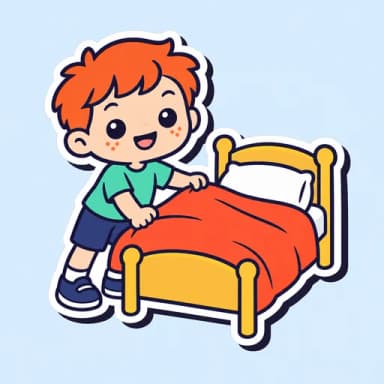
Make your bed
- 2

Get dressed by yourself
- 3

Wash your face
- 4

Brush your teeth
- 5

Brush your hair
- 6

Drink a glass of water
Chore ideas and guides at kidventures.app
In the print window, choose "Save as PDF" as the printer to keep a file.
In short
A routine chart shows the same steps in the same order every day, with a picture for each step, so children who cannot read yet can follow it alone. Keep it short for young children and add a step only when the current ones run smoothly.
How to use it
- Choose morning, after school or bedtime, and your child's age.
- Keep, remove, add or reorder the steps with the arrows. Add clock times if your child reads the time.
- Print it as a picture strip or a checklist and hang it where the routine happens.
Worked example: a 6 year old's school morning
With Morning and ages 5 to 6, the chart starts with these steps: Make your bed, Get dressed by yourself, Wash your face, Brush your teeth, Brush your hair, and Drink a glass of water.
Turn on clock times and count back from when you leave: if the door closes at 8:00, getting dressed at 7:15 leaves room for breakfast. After a week, let your child point to the next picture instead of telling them what comes next.
How many steps by age?
Younger children manage fewer steps. The chart starts with 3 steps at age 2, 4 at ages 3 to 4 and 6 from age 5. These are practical starting points: watch your child and add a step only when the current ones run without reminders.
The bedtime version and sleep
A consistent bedtime routine is linked with young children falling asleep faster, waking less and sleeping longer, according to a review of the research (Mindell and Williamson, 2018). The American Academy of Sleep Medicine recommends 10 to 13 hours per 24 hours for ages 3 to 5, naps included, and 9 to 12 hours for ages 6 to 12 (Paruthi and colleagues, 2016). Count back from wake-up time to set lights out.
My bedtime
Name
- 1

Tidy your toys
- 2

Take a bath or shower
- 3

Put on your pajamas
- 4
Brush your teeth
- 5

Read before bed
- 6

Pack your school bag
Chore ideas and guides at kidventures.app
Routines for children with ADHD or autism
Many families of children with ADHD or autism use picture routines because they make the next step visible. The same chart works: fewer steps, 1 picture per step and the same order every day. Ask your child's doctor or therapist for advice that fits your child.
Questions parents ask
What should be on a morning routine chart?
The steps your child does every school morning, in order: getting up, getting dressed, washing, brushing teeth and hair, shoes and bag. The chart suggests them from our library by age; remove what does not apply to your family.
How many steps for a 4 year old?
Start with 3 or 4 steps with pictures and stay close by. Add 1 step at a time once your child follows the first ones without reminders.
Pictures or words?
Pictures for children who cannot read yet, pictures and words for early readers, and a checklist for older children. The chart prints both layouts.
How long until a routine sticks?
It varies a lot. In a study of adults forming a new daily habit, the time until it felt automatic ranged from 18 to 254 days (Lally and colleagues, 2010). Expect weeks, keep the same order and praise the steps done.
Keep reading
Turn this routine into daily quests
Each step becomes a quest with its picture. Kids tick it on a tablet and you approve in 1 tap. Free for up to 2 kids.
Sources
Checked on October 17, 2026
- Mindell and Williamson (2018), Benefits of a bedtime routine in young children, Sleep Medicine Reviews 40
- Paruthi and colleagues (2016), Recommended amount of sleep for pediatric populations, American Academy of Sleep Medicine
- Lally and colleagues (2010), How are habits formed, European Journal of Social Psychology 40(6)